Understanding Flange Standards: Ensuring Safety and Compatibility in Piping Systems | Platinex Piping Solution
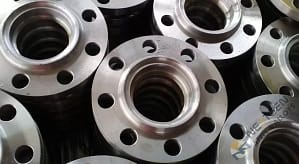
A crucial component in piping systems – Flanges, serve as connectors that join pipes, valves, and other equipment. They play a vital role in maintaining the integrity and functionality of these systems. However, it is essential to adhere to flange standards to ensure proper installation and performance.
- The Importance of Flange Standards: Flange standards commits specifications and guidelines for the design, dimensions, materials, and testing of flanges. These standards ensure consistency and uniformity in flange manufacturing, hereby facilitating interchangeability and compatibility across different suppliers and industries. The engineers and manufacturers can trust that flanges will meet the necessary requirements for safe and reliable operation.
- ANSI/ASME Flange Standards: The American National Standards Institute (ANSI) and the American Society of Mechanical Engineers (ASME) publish widely used flange standards in the United States. ANSI/ASME B16.5 is one such standard that covers tolerances, dimensions and marking requirements for pipe flanges and flanged fittings. In order to accommodate various operating conditions, it categorizes flanges into different pressure classes, ranging from 150 to 2500.
- EN Flange Standards: The flange standards are governed by the European Committee for Standardization (CEN). EN 1092-1 is a notable standard that specifies requirements for flanges and their jointing surfaces. It includes ensuring compatibility and safety in European piping systems and specifications for flange types, dimensions, materials, and pressure ratings.
- DIN Flange Standards: The German Institute for Standardization (DIN) publishes widely recognized flange standards in Europe. DIN standards, such as DIN 2501 and DIN 2633, define materials, and testing methods for various types of flanges, including welding neck flanges and slip-on flanges. These standards contribute to the reliability and performance of piping systems in industries across the globe.
- JIS and BS Flange Standards: Other regions, such as Japan and the United Kingdom, have their own flange standards. The Japanese Industrial Standards (JIS) specify material and dimensions for steel pipe flanges and flanged fittings in JIS B2220. Similarly, British Standards (BS) provide guidelines for flange design and performance in standards like BS 4504. These standards express quality and consistency in flange manufacturing worldwide.
Flange standards play a crucial role in ensuring reliability, capability and safety, in piping systems. Engineers and manufacturers can design, manufacture, and install flanges with confidence, by adhering to recognized standards such as ANSI/ASME, EN, DIN, JIS, and BS. These standards provide comprehensive guidelines for flange design, dimensions, materials, and testing, thereby contributing to the efficiency and integrity of piping systems across various industries.
.jpg)
.jpg)
Comments
Post a Comment